
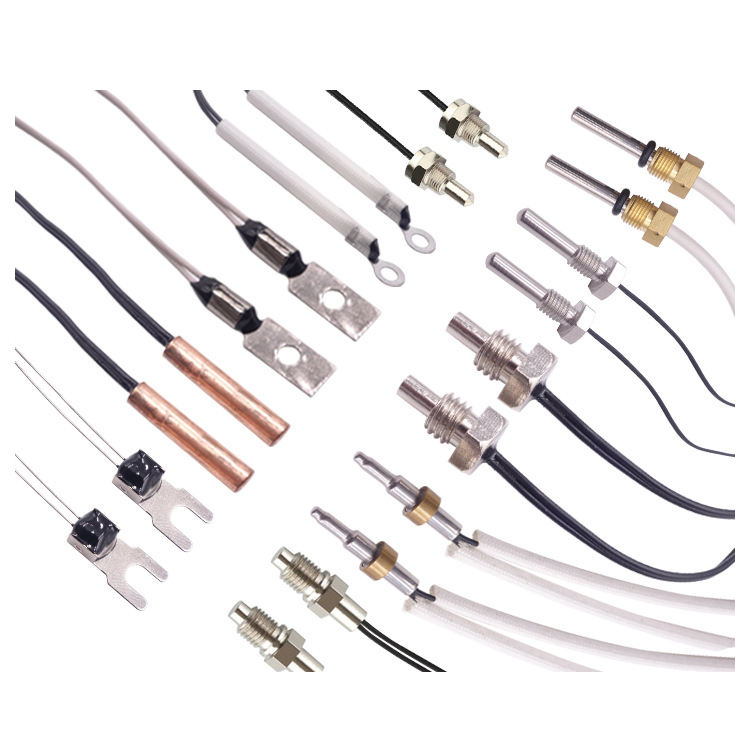
NTC, RTD, Thermocouple, Digital Sensor or Which Output Type?
Temperature measurement is critical in HVAC systems, industrial equipment, automotive applications, medical devices, and smart electronics.
But with so many options available, how do you select the right temperature sensor?
The key is to consider:
✅ Temperature Range
✅ Accuracy Requirement
✅ Response Time
✅ Working Environment
✅ Output Signal
✅ Installation Method
1. NTC Thermistor — Cost-Effective & High Sensitivity
Best for: Home Appliances | HVAC | Battery Systems | Consumer Electronics
NTC (Negative Temperature Coefficient) thermistors provide excellent sensitivity and fast response at a competitive cost.
Advantages:
✔ Low cost
✔ Small size
✔ Fast response
✔ High sensitivity in a limited temperature range
Typical Applications:
- Air conditioners
- Refrigerators
- Water heaters
- Battery temperature monitoring
2. RTD (PT100/PT1000) — High Accuracy & Stability
Best for: Industrial Control | Process Measurement | Precision Equipment
RTD sensors use the predictable resistance change of platinum elements to achieve accurate temperature measurement.
Advantages:
✔ Excellent accuracy
✔ High stability
✔ Good repeatability
✔ Long service life
Common types:
- PT100
- PT1000
Available configurations:
- 2-wire
- 3-wire
- 4-wire
Ideal for applications requiring reliable and precise temperature monitoring.
3. Thermocouple — For Extreme Temperature Applications
Best for: Furnace | Oven | High Temperature Equipment
Thermocouples generate a voltage according to temperature differences and are widely used in high-temperature environments.
Advantages:
✔ Very wide temperature range
✔ Fast response
✔ Durable construction
Common types:
- Type K
- Type J
- Type T
- Type S
4. Digital Temperature Sensor — Smart & Easy Integration
Best for: IoT | Smart Devices | Electronics
Digital sensors provide temperature data directly through communication interfaces.
Common outputs:
- I²C
- SPI
- 1-Wire
- RS485
Advantages:
✔ Easy connection with MCU systems
✔ Digital signal transmission
✔ Reduced signal interference
✔ Compact design
Choosing the Right Output Signal
The sensor output should match your control system.
Resistance Output
NTC / PT100 / PT1000
✔ Direct resistance measurement
✔ Simple structure
✔ Common in HVAC and controllers
Current Output
4-20mA Temperature Transmitter
✔ Long-distance transmission
✔ Strong anti-interference ability
✔ Widely used in industrial automation
Voltage Output
0-5V / 0-10V
✔ Easy connection with PLC and control systems
✔ Suitable for automation equipment
Digital Output
RS485 / I²C / SPI / 1-Wire
✔ Smart communication
✔ Suitable for IoT and intelligent systems