
A Complete Guide for Industrial and HVAC Applications
Temperature and humidity measurement plays an important role in HVAC systems, industrial automation, agriculture, laboratories, storage facilities, and smart buildings.
Choosing the right temperature and humidity transmitter is not only about measuring temperature and humidity — it is about selecting the right installation method, accuracy, output signal, and sensor design for your application.
So, how do you choose the most suitable temperature and humidity transmitter?
1. Choose According to Installation Method
Different installation environments require different transmitter designs.
① Wall-Mounted Temperature & Humidity Transmitter
Best for: HVAC | Smart Buildings | Offices | Clean Rooms
Wall-mounted transmitters are installed directly on walls to monitor indoor air conditions.
Features:
✔ Easy installation
✔ Good air circulation design
✔ Suitable for continuous monitoring
Typical Applications:
- Air conditioning systems
- Office buildings
- Data centers
- Laboratories
- Clean rooms
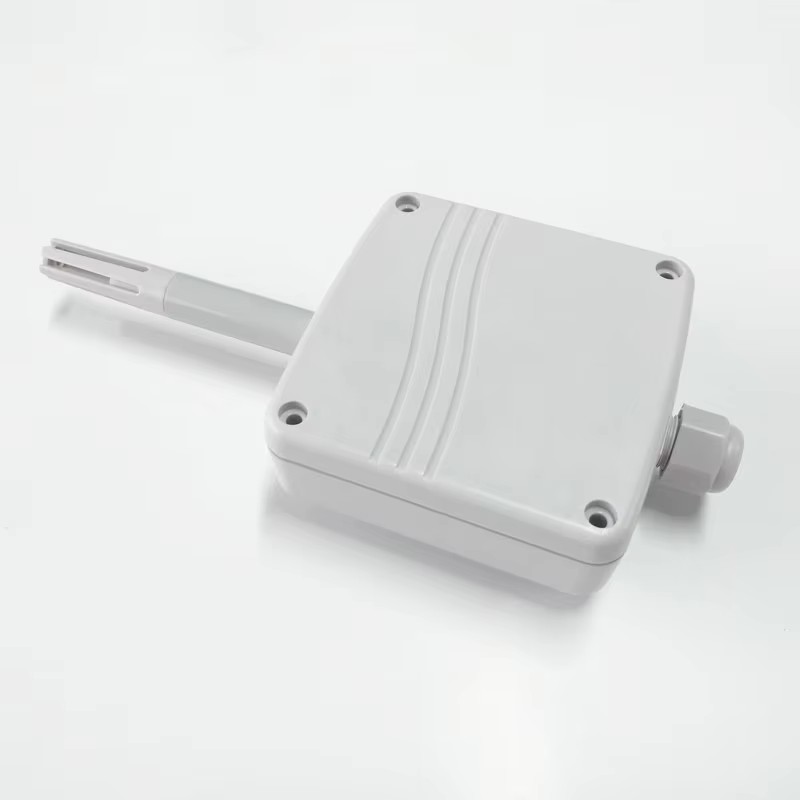
② Duct Temperature & Humidity Transmitter
Best for: HVAC Air Duct Systems
Duct transmitters are installed inside ventilation ducts to measure the temperature and humidity of airflow.
Features:
✔ Accurate air measurement
✔ Long probe design available
✔ Suitable for centralized HVAC systems
Applications:
- Air handling units (AHU)
- Ventilation systems
- Industrial air conditioning
③ Probe-Type Temperature & Humidity Transmitter
Best for: Equipment Monitoring | Industrial Applications
Probe-type transmitters use a sensing probe inserted into the measurement area.
Features:
✔ Flexible installation
✔ Suitable for narrow spaces
✔ Fast response
Applications:
- Industrial machines
- Environmental monitoring
- Test equipment
④ Outdoor Temperature & Humidity Transmitter
Best for: Weather Monitoring | Agriculture | Building Management
Outdoor transmitters are designed to withstand environmental conditions.
Features:
✔ Waterproof protection
✔ UV-resistant housing
✔ Stable long-term operation
Applications:
- Greenhouses
- Weather stations
- Smart agriculture
- Building automation
2. Choose According to Application Field
Different industries have different requirements.
HVAC & Building Automation
Recommended:
- Wall-mounted transmitter
- Duct transmitter
Key requirements:
✔ High stability
✔ Easy integration
✔ RS485 / 4-20mA output
Industrial Automation
Recommended:
- Probe-type transmitter
- High protection housing
Key requirements:
✔ High accuracy
✔ Strong anti-interference ability
✔ Long service life
Agriculture & Greenhouse
Recommended:
- Outdoor transmitter
- High humidity resistance design
Key requirements:
✔ Wide humidity range
✔ Long-term stability
✔ Real-time monitoring
Data Centers & Server Rooms
Recommended:
- High accuracy temperature & humidity transmitter
Key requirements:
✔ Fast response
✔ Stable communication
✔ Alarm monitoring capability
3. Select the Right Output Signal
The output type determines how the transmitter communicates with your control system.
4-20mA Current Output
Ideal for industrial applications
Advantages:
✔ Long-distance transmission
✔ Strong anti-interference capability
✔ Compatible with PLC systems
0-5V / 0-10V Voltage Output
Ideal for control systems
Advantages:
✔ Simple connection
✔ Easy signal processing
✔ Widely used in automation equipment
RS485 Communication (Modbus RTU)
Ideal for smart monitoring systems
Advantages:
✔ Digital communication
✔ Multiple devices networking
✔ Long communication distance
WiFi / IoT Output
Ideal for smart buildings and remote monitoring
Advantages:
✔ Wireless transmission
✔ Cloud monitoring
✔ Intelligent management
4. Consider Accuracy Requirements
Different applications require different accuracy levels.
General Applications:
Temperature:
±0.5°C ~ ±1°C
Humidity:
±3%RH ~ ±5%RH
Precision Applications:
Temperature:
±0.1°C ~ ±0.3°C
Humidity:
±1%RH ~ ±2%RH
High-accuracy sensors are recommended for:
- Laboratories
- Pharmaceutical storage
- Precision manufacturing
5. Consider Protection Level and Environment
Before selecting a transmitter, consider:
✔ Indoor or outdoor installation
✔ Dust and water exposure
✔ Temperature range
✔ Chemical environment
✔ Installation space
Common protection levels:
IP54
Suitable for indoor applications
IP65
Suitable for industrial and outdoor environments
6. Customization Options
Every application is different.
A professional temperature & humidity transmitter manufacturer can provide customized solutions:
✔ Different probe lengths
✔ Different housing designs
✔ Customized temperature range
✔ Customized humidity range
✔ Customized output signals
✔ OEM & ODM services